
BedtimeHero Blog
Same Time, Close By: What New Bedtime Research Says
Two recent studies point to what helps kids at bedtime: a steady sleep time and a few minutes of closeness. Plus how to protect both when clocks fall back.

Bedtime advice usually comes as a long list: dim the lights, run a bath, no screens, white noise, the right nightlight. It's easy to finish that list feeling like you're failing at nine things at once.
So it's worth paying attention when researchers try to figure out which pieces actually matter. Two recent studies did just that, one with 6-year-olds and one with 3- and 4-year-olds. Neither is the final word, but together they point to two pretty doable ideas: keep sleep time steady, and stay close for a few minutes before lights out.
And with clocks falling back on Sunday, November 1, in U.S. regions that observe daylight saving time, there's a real-world test of the first idea coming up in a few weeks. Here's what the studies found, what they don't prove, and what you can do with them.
Study 1: A steady sleep time was linked to better self-regulation
In late 2024, researchers at Penn State published a study of 143 six-year-olds in the Journal of Developmental and Behavioral Pediatrics. The children wore a wrist sleep monitor for seven days. They also did two tasks while researchers watched.
In one, a child's chosen toy was locked in a clear box, and none of the keys they were given worked. Researchers watched how kids handled the frustration. In the other, children decorated a picture frame with a parent while researchers looked for cooperation versus things like talking back (Penn State News).
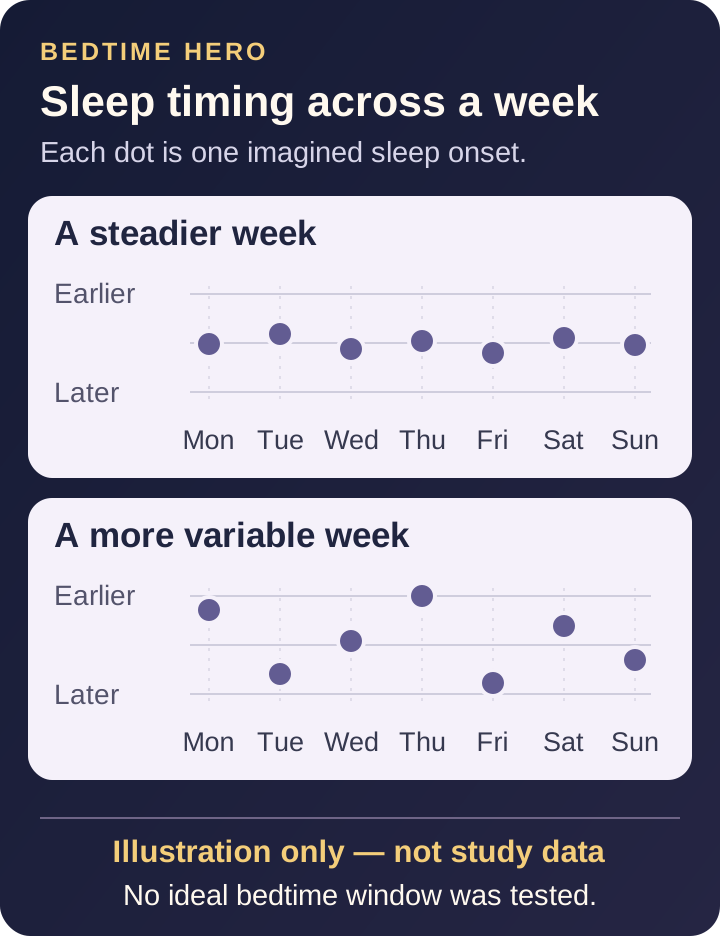
Here's the surprising part. How long kids slept on average, and how well they slept, weren't linked to how they behaved in these tasks. That doesn't mean sleep duration is unimportant; this was one study with these particular tasks. What was linked was how much their sleep time bounced around from night to night. Kids whose time of falling asleep varied more showed more impulsivity and poorer emotion regulation (JDBP study via PMC).
The press release illustrates the pattern by comparing 20 minutes of bedtime variation with two hours. Those numbers aren't a tested threshold or a recommended window. The study measured the standard deviation of sleep-onset times across the week. As lead author Adwoa Dadzie put it, "Children who had consistent bedtimes were generally able to regulate their behavior and emotions" (Penn State News).
What it doesn't prove
The authors are upfront about the limits. The study is a snapshot, and they write that its cross-sectional design "precludes conclusions about the causal direction" of the link. It's possible that kids who are harder to settle end up with more irregular bedtimes, rather than irregular bedtimes making kids harder to settle. The families also came from one hospital, and 95% of the children were non-Hispanic white, so the results may not apply to every family. And seven days of data meant the researchers couldn't separate weeknights from weekends (JDBP study via PMC).
Study 2: Cuddles and baths showed promising, uncertain links
The second study is newer and smaller, but it's clever. A team including researchers from New Zealand's University of Otago had 70 healthy 3- and 4-year-olds wear a sleep monitor for seven nights. On five of those nights, the kids also wore a small chest camera for the two hours before bed. That let researchers see what actually happened, instead of relying on parents' memories (SLEEP Advances, October 2025).
They then compared activities in the hour before bed with how long each child slept that night. A few findings stood out:
- Connection activities. Cuddling was associated with an estimated 16 minutes more sleep, with a 95% credible interval from 11 minutes less to 43 minutes more. The bath or shower estimate was 15 minutes more, with a 95% credible interval from 9 minutes less to 38 minutes more. Both intervals include zero.
- Screens. There was little evidence of an association between screen time in the hour before bed and sleep duration. The estimate was less than one minute less sleep per 10 minutes of screen time.
- Audiobooks. These were uncommon. The results pointed toward less sleep, but the estimate was very uncertain. The authors say more research is needed, including whether kids who were already having a hard time settling were the ones given audiobooks.
The authors concluded that their findings are "consistent with connection activities involving caregivers supporting young children's sleep."
What it doesn't prove
This one needs even more caution. This report is a conference abstract rather than a full study report, and the authors call their analyses exploratory. The ranges around the cuddling and bath estimates are wide enough to include zero, so "about 16 minutes" is a best guess, not a promise.
The screen finding is the one most likely to get overstated online, so here's the plain version. In this small group, measured this way, there was little evidence of an association between screen time in the hour before bed and that night's sleep duration. That doesn't mean screens before bed are fine. It says nothing about what kids watched, devices in the bedroom, or effects over months. The American Academy of Pediatrics still recommends turning screens off at least an hour before bed and keeping them out of kids' bedrooms (HealthyChildren.org).
One more honest note: the researchers coded story time as one of the activities, but the abstract doesn't report a result for it. So we can't say from this study that reading made a difference, even though we'd love to.
What to do with this tonight
If you take one thing from these studies, let it be this: you don't have to perfect the whole routine. A few things look worth protecting.
1. Pick a lights-out time and guard it within a small window. You don't need military precision. The study didn't establish an ideal window. Choose a time that works on your busiest weeknight, then aim for it every night, weekends included.
2. Put a few minutes of closeness right before lights out. A cuddle, a back rub, a quiet chat about the best part of the day, or a story read snuggled together. The preschool study found a possible association between cuddling and sleep duration, though the estimate was uncertain.
3. Watch the drift, not the occasional late night. A wedding or a holiday won't undo anything. What the Penn State study measured was a whole week of variability, so a pattern of late nights is what's worth catching.
Plan ahead for the time change on November 1
In U.S. regions that observe daylight saving time, it ends Sunday, November 1, 2026, and clocks fall back an hour (NIST). For many families with young kids, that means a 6:00 a.m. wake-up turns into 5:00 a.m. That's a real test of a steady bedtime.
The American Academy of Sleep Medicine's tips include shifting bedtime 15 to 20 minutes later each night for a few nights before the fall change, moving other routines like mealtimes along with it, and in the fall, keeping light exposure low until your target wake time in the morning (AASM Sleep Education). Those tips are written for everyone, not specifically for kids, so treat them as a starting point. Some ideas for this age group:
- Start the Wednesday or Thursday before. Move the whole routine, story and cuddles included, 15 minutes later each night so Sunday's new clock time feels normal.
- Keep the routine the same, just later. Same steps, same order, same goodnight. The routine itself is a signal kids recognize even when the clock changes.
- Keep early mornings dim. If your child is up before the new wake time, keep lights low and the morning quiet until it's time to start the day.
- Know the exception. The AASM notes that if you're already short on sleep, you may be better off not shifting later and simply taking the extra hour. If your child has been running on too little sleep lately, the fall-back weekend can be a chance to catch up.
A small, steady habit
Neither study describes a perfect bedtime. What they suggest is gentler: about the same time each night, and a few minutes close together before the lights go off.
Some families make that closeness about a story. With Bedtime Hero, you pick a theme and the app makes an illustrated storybook starring your child, an easy reason to curl up together at the same time each night. As one parent wrote in an App Store review, "My [son] and I make a story every night. It's our new nighttime ritual."
Bedtime Hero is free to download (with in-app purchases), has no ads, and new users get a free starter book. Get Bedtime Hero on the App Store.
Sources
- Dadzie A, et al. "Associations Between Sleep Health and Child Behavior at Age 6 Years in the INSIGHT Study." Journal of Developmental and Behavioral Pediatrics, 2025;46(1):e56–e63 (online November 8, 2024). Read on PMC. Checked October 4, 2026.
- Penn State News. "Consistent bedtime linked with better child emotion and behavior regulation." November 11, 2024. Read on psu.edu. Checked October 4, 2026.
- Kuroko S, et al. "Preschoolers' bedtime activities and subsequent sleep: a wearable camera study." SLEEP Advances, 2025;6(Supplement 1):A1 (conference abstract, published October 3, 2025). Read on Oxford Academic. Checked October 4, 2026.
- American Academy of Sleep Medicine. "Daylight Saving Time." Sleep Education. Read on sleepeducation.org. Checked October 4, 2026.
- American Academy of Pediatrics. "Healthy Sleep Habits: How Many Hours Does Your Child Need?" HealthyChildren.org. Read on healthychildren.org. Checked October 4, 2026.
- National Institute of Standards and Technology. "Daylight Saving Time (DST)." Read on nist.gov. Checked October 4, 2026.